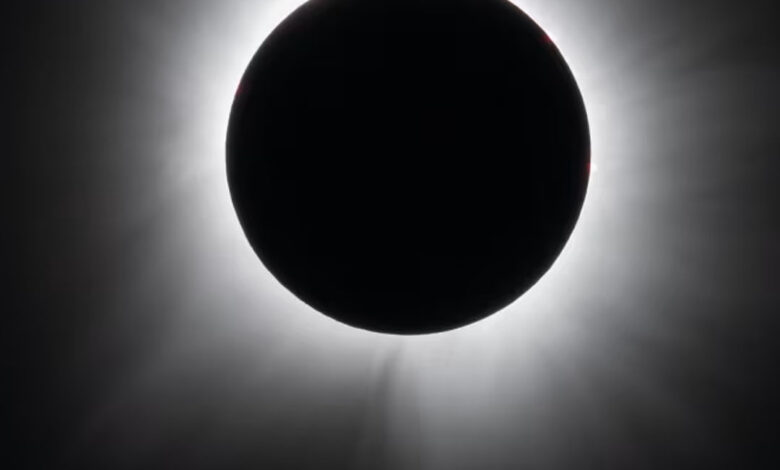
Lahore (Finale) One of the most anticipated astronomical events of the year is set to captivate millions around the world this summer as a total solar eclipse takes place on August 12, 2026.
The rare celestial phenomenon will occur when the Moon moves directly between the Earth and the Sun, completely blocking the Sun’s face for observers located within the path of totality. During this brief period, daylight will dramatically fade, stars and planets may become visible, and the Sun’s glowing outer atmosphere, known as the corona, will appear around the darkened lunar silhouette.
Astronomers say the eclipse will attract the attention of scientists, photographers, tourists, and astronomy enthusiasts from around the world. Several European countries, particularly Spain, are expected to be among the prime viewing locations, with local authorities already preparing for large crowds and special public observation events.
The eclipse path will extend across parts of the North Atlantic, Greenland, Iceland, and Europe, offering varying levels of visibility depending on location. While observers inside the path of totality will experience complete darkness for a short period, millions more outside the central path will witness a partial solar eclipse.
Experts recommend that viewers use certified eclipse glasses or approved solar viewing equipment when observing any phase of the eclipse except during the brief period of totality for those located within the eclipse’s central path. Looking directly at the Sun without proper eye protection can result in serious and permanent eye damage.
Astronomical organizations and observatories are planning educational programs, public viewing events, and live broadcasts to help people safely enjoy the phenomenon. Hotels and tourism operators in key viewing regions have reported increased interest from travelers hoping to witness the eclipse firsthand.
According to eclipse forecasts, the event will begin over the North Atlantic, reach maximum eclipse during the late afternoon, and conclude during the evening hours. Exact viewing times and durations will vary by location.
Weather conditions will play a crucial role in visibility, with clear skies offering the best opportunity to experience the eclipse. Meteorologists and astronomy experts are expected to provide regular updates as the event approaches.
Total solar eclipses remain among the most dramatic natural phenomena visible from Earth. For many observers, the August 2026 eclipse will provide a once-in-a-lifetime opportunity to witness the remarkable alignment of the Sun, Moon, and Earth in a breathtaking display of celestial mechanics.